
Stargate SG-1, the successful television sequel to the 1994 Stargate movie, created compelling stories while forging new ground in science-fiction. Throughout its 10 year run, the personalities of the four main characters were as engaging an element as unexplored planets and new alien species. In honor of its 25th anniversary and continuing influence, we’ve analyzed the personalities of the four main members of SG-1 using the Myers-Briggs Type Indicator, as understood through Carl Jung’s functions, which involve the order and preference of four main modes (Intuition, Sensing, Thinking, and Feeling) oriented in either an extraverted or introverted manner. A good explanation of this personality tool can be found here. With that, let’s get to our best guesses at SG-1’s personalities!

DANIEL JACKSON – INFP (Fi-Ne-Si-Te)
Despite the personal losses the Stargate program brought into his life, Daniel Jackson remains the idealist, always believing in the untapped potential for good it represents. His primary lens is introverted feeling, as he is usually the first of the team to raise ethical questions and act according to personal values—sometimes to an impractical degree. While still being respectful of the value of culture, Daniel will often diplomatically attempt to convey to alien societies where they might be deficient in appreciating the individual, as demonstrated by his negotiations in “Scorched Earth.”
When bringing up ethical questions, Daniel usually does so through extraverted intuition, posing possible solutions for the team’s consideration that look at situations from entirely new vantage points—occasionally to the exasperation of O’Neill, who draws Daniel back from nebulous abstractions to concrete specifics. Daniel is quick to point out the valuable meanings of sites and artifacts, with each new culture and language providing him with compelling insights. Along with Carter, he is often the first to forge relationships with aliens, themselves indicative of exciting possibilities. Whether it’s the irresistible trove of Ancient wonders in “The Torment of Tantalus” or the chance to understand elusive lifeforms, Daniel’s wonder at life and the universe finds expression in an ever expanding web of intuitive ideas and theories.
Daniel’s tertiary function of introverted sensing shows a strong sense of the past, as exemplified by his archaeological pursuits and his respect for cultural heritage. Daniel can easily identify symbols and languages the team has previously seen, and he will often assume that his past experiences are valid and reliable examples in support of broader claims. Memories are a major influence on him, especially those of his wife.
Daniel’s inferior function, extroverted thinking, crops up in both beneficial and detrimental ways. Daniel seeks to order his knowledge, often “thinking out loud” on chalk boards or with the team; again, Jack presses him to get to the point, helping emphasize that Daniel’s Te supports his primary extroverted mode of intuition rather than being fully developed and succinct, as it is for Teal’c. Thus, Daniel sometimes struggles and is exasperated when trying to communicate his thoughts, wanting time to hone them properly.
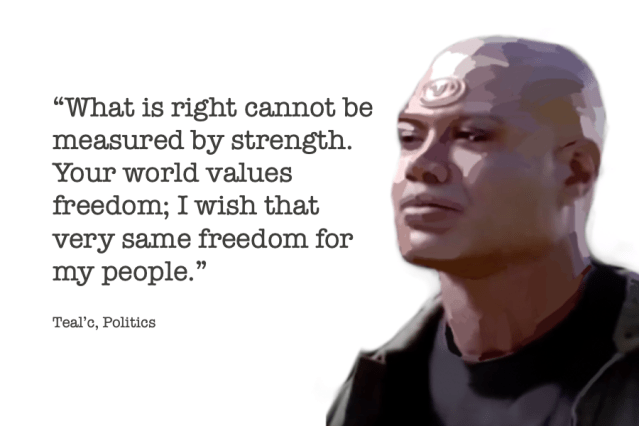
TEAL’C—ISTJ (Si-Te-Fi-Ne)
Teal’c, the stoic and skilled former first prime of Apophis, exhibits a primary mode of introverted sensing, evidenced in strong loyalty to his Jaffa heritage. He wishes to free it from false servitude, while defending its tradition and innate ideals of honor. His former life plays a formative role in his actions; remembering who he was serves both as an ethical guidepost and a touchstone for building relationships with those in similar situations. His accurate memory of Gua’uld tactics and technology is a major asset to the team. The interior structure of Teal’c’s Si is further highlighted through his practice of Kelno’reem, a deep, meditative state.
When communicating himself, Teal’c exhibits extraverted thinking; logic comes readily to him, granting both coolness and quickness in battle situations. He does not speak often, but when he does it is in a concise, accurate way that is much appreciated by Jack. Laying out his rationale and goals in the clearest of terms, Teal’c is easily able to cut through the vague insinuations of someone like Senator Kinsey.
Teal’c reveals strong introverted feeling in his sense of loyalty and honor, both to the Jaffa and to General Hammond. His expulsion from the Jaffa ranks as a traitor and the resulting shame on his family hurts him deeply, but this same fact lends even greater strength to his conviction to join SG-1 in resistance of the Gua’uld. He often appreciates Daniel’s moral insistence, even while acknowledging the logic of a move that contradicts it for practical reasons.
Teal’c’s inferior function is extraverted intuition, which often crops up in pessimistic ways, as he will frequently provide multiple scenarios of what could go wrong with a plan. This tendency emerges especially in the negatively self-fulfilling scenarios of “Avatar.” Despite this, the possibilities entertained by extraverted intuition strongly accompanied his extraverted thinking in the critical decision to accept Jack’s offer of rebellion against the Gua’uld in “Children of the Gods.”

SAMANTHA CARTER—ENTP (Ne-Ti-Fe-Si)
Samantha Carter, the intrepid and talented scientist, is primarily motivated by the possibilities of extraverted intuition. Her interaction with the world and her mode of communication is filled with opportunities to engage with new technology and to meet potential allies. She often counters Teal’c’s pessimistic Ne, responding with, “Not necessarily . . .” followed by a possible solution. She does not mind defending her point, especially when aided by incisive Ti.
Sam’s Ne is balanced by a strong introverted thinking. She explores and asks questions with Ne, but then keeps her assessment close, unless asked for it by Jack or another team member. When she does relay her precise understanding, it is often accused of being too detailed, at which point she will cut to the practical application of her discovery, thus reverting to her primary, intuitive mode of communication. An encounter with new technology spurs her to understand it from the inside out; Sam can spend long amounts of time alone if there is something new with secrets to be uncovered.
Underlying her sometimes clinical first two functions, Sam shows a warm and altruistic side through extraverted feeling. She is often the first to note tensions within the team and seek to fix them, as when she discusses the emotional matters her father resists confronting, ultimately facilitating his reconciliation with her brother in “Seth.” Sam fits more easily into the military milieu and chain of command than Jack does, and she requires time and conversation to process through emotions, especially those of the Tok’ra Jolinar.
Sam’s inferior function is introverted sensing. She has a reliable memory of technology and people encountered, an ability further enhanced by the memories of Jolinar. She is adept at building off of her past experience with technology, however, engaging in routine tasks or memory recall for intense or extended periods is often draining for her.

JACK O’NEILL — ESFP (Se-Fi-Te-Ni)
The oft irreverent but capable leader of SG-1, Jack O’Neill is excellent at operating in the present moment and can quickly become attuned to his surroundings, even on strange worlds or alien spaceships. With extraverted sensing, he is always looking, touching, and assessing his immediate environment. Though this often involves risk, as when he touches the crystal in “Cold Lazarus,” Jack usually demonstrates awareness of when sensory activities would be dangerous, warning Daniel and Sam away from unduly reckless exploration. He is extremely exasperated by the repetitious activities of “Window of Opportunity,” until a possibility suggested by Daniel leads him to make use of its no-consequences nature to try a number of new and cheeky experiences.
Where Daniel’s Fi is tempered by the curiosity of Ne, Jack’s introverted feeling is secondary to the experienced situation and acts accordingly, as when he readily assists the besieged, underdog Eurondans in “The Other Side.” When Jack later experiences the alternate scenario Daniel had posited, his repositioning about them is as immediate and steadfast as his initial objections had been. Generally, Jack has a hard time accepting the standards of other cultures when they conflict with his own or the safety of his team, and he is fine with both questioning orders and amending them as he sees fit. However, if he respects an authority figure, such as General Hammond, that person has his unwavering loyalty. After a significant Se experience, Jack needs time to be alone and to process his emotions through introverted feeling, rather than airing them to another person (also shown in “Cold Lazarus.”)
Jack’s tertiary function, extraverted thinking, shows itself most in ready quips and comebacks, which, in combination with his primary Se, are often irreverent of authority and tradition. He prefers his information to be immediate and concise, having little patience for either Daniel’s abstract possibilities or Sam’s intricate and detailed findings. Though it can at times be lacking in diplomacy, Jack’s extraverted thinking naturally hews to the simplest and quickest solution.
Jack’s inferior function is introverted intuition. On a good day, he keeps in mind the main goal of a mission, never neglecting it for what might spring up along the way. He would rather know and be acting toward the ultimate objective than get bogged down in the many ways in which it can be accomplished or might fail. Thus, a bad day for Jack is when he is out of tune with the point of the SGC, as when there are politics involved.
 The Intentional Ordinary